By its very nature, the subject of the divine will is complex and mysterious. On the one hand, it is established in eternity, being rooted in God's knowledge, volition and ability, while on the other hand, it is only realised in the dynamics of human history. The need to harmonize this dual nature of the Will of God has resulted in numerous theories, which are often antagonistic and typically of little help to the ordinary believer who desires to make sense of His Father's counsel in a way that both answers biblical difficulties and help his daily walk with God.
It is therefore necessary to make clear doctrinal statements on this important issue to aid believers in their bid to serve God acceptably.
In spite of the different words employed in the scriptures for the divine will which have tended to acquire unique technical meanings, it has become standard to recognise them under either of two labels: Divine Decrees (preferred by seminarians) or simple Divine Will by the rest of the brethren. In my use of these words, I have chosen to be more grammatical than technical in the hope that the message will have smoother passage to the heart and minds of believers.
Essential Nature
On account of His perfect knowledge, God not only knows all things that can be, He also knows, in every detail, all things that will actually be. This very fact of divine knowledge makes their historicity certain, but the personal desire of God as well as His direct involvement in the performance of this certainty has been the crux of contention in the Church for centuries especially between Calvinists and Arminians. Whatever view one holds, what is not debatable is that God's knowledge does not imply moral approval or personal implementation of things that do come to pass.
But God has not left us without help. He has duly provided for mankind, every guide and enablement required both to know and to do His will. The Bible says,
"And this is the WILL of Him who sent Me, that everyone who sees the Son and believes in Him may have everlasting life: and I will raise him up at the last day" (John 6: 40)
With Jesus as the way, the truth and the life of our lives, knowledge of and alignment with the will of God is assured. On this basis, I have adopted a simple model to guide the believer in understanding the divine will.
A Four-Cell Grid
Basically, God's will is either of the things that He personally desires, i.e. His perfect will or those that He merely allows i.e. His permissive will. God's perfect will may be decreed or it may be preceptive while His permissive will is either mercifully condoned or judgementally condemned.
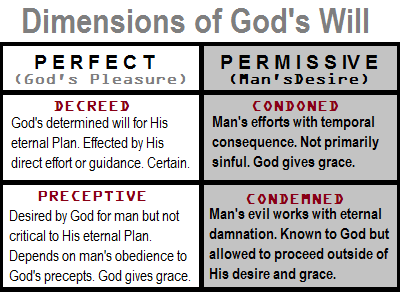
The following notes give some details:
Perfect Will
These concern things that are God's personal desire in holiness. They are His 'good pleasure'. However, it is necessary to recognise and differentiate two sub-categories of the divine perfect will.
DECREED WILL
These are based on His absolute sovereignty and wisdom, and are required for His eternal counsel. It is of this category that the Scripture says "what has been determined shall be done" (Daniel 11:36). They are inviolable and not susceptible to prayer or petition. God Himself will personally
implement them and shall not relent.
Examples include creation, allowance of the Fall, redemption, sojourn of Hebrews in Egypt, incarnation of Christ, Resurrection, Second Coming of Christ, Eternal Judgement, e.t.c. The life destiny of some people are already woven into the decreed will of God and therefore, such people
will invariably perform the role preordained for them, such as Cyrus, the Persio-median king. But such invariable fate in not the standard. Normally, the destiny of human beings and even nations fall under the preceptive will of God, as discussed next.
PRECEPTIVE WILL
The second category of God's perfect will is that premised upon the principles of His word shared with us. Through His word, God reveals to us what His perfect desire for us are both in our relationship with Him and in our personal lives and interactions with the rest of creation. They are
His precepts for OUR good and are not required for the achievement of His eternal counsel. They are however profitable for us, individually or in groups.
God will supply all the needful equipping (Phil. 2:13) to make these possible BUT will not personally execute them. He will not compel their implementation. Man has to utilise the provisions so as to attain them. Prominent in these provisions are faith and obedience. If he fails, it is
man's personal loss. God's eternal counsel is not affected one way or the other.
The exercise of the preceptive will of God includes our repentance and salvation, financial prosperity, good health, career success, fulfillment of destiny, e.t.c. All these are God's perfect will for every man, but we know that most of us miss some or even all of these. The great majority
of mankind live outside the salvation of God while many of those that have found grace to be born again are still burdened by sickness, poverty and failures. None of this is the will of God. Preceptive will is premised on divine principles and is therefore not automatically attained. People
like Eli, Saul, Jonathan, Elijah, Iscariot even missed the fullness of their life destinies.
In addition to the 'loss' suffered, sin and eternal damnation may also be imputed if the failure of achievement is due to willful disobedience to God e.g son of perdition like Judas Iscariot who having been justified went ahead to apostacy.
One thing we must take away concerning God's perfect will is that He acts automatically for all things related to His decreed will but we need to pray and live purposely to move Him concerning preceptive will.
Permissive Will
Relates to all things that are not the perfect personal desire of God but which all the same He, under His full knowledge (but not approval) permits to proceed and be effected by His created beings whom He had bestowed with free agency. Technically, whatever is not perfect will is permissive will.
Again, there are two varieties of permissive will: (a) Condoned and (b) Condemned
CONDONED
Under this group are human activities whose consequenses are limited to temporal realm. This is to say that although the issues originate in the heart of man instead of God, they are not primarily sinful and would not ordinarily lesd to eternal damnation. They come via two channels:
1. Imperfect execution (underachievement) of perfect preceptive will.
The sad reality is that most of us, Christians live under this form of permissive will, one way or the other. We settle for less-than-perfect options. From the Scriptures, the lives of Jehu, Samson and Jonathan readily come to mind. In us as modern-day believers, mediocrity and lack of endurance
to the end often plague us.
Are we sufficiently aware that evangelising ten souls means operating under permissive will if we have been equipped to evangelise a hundred? All other areas of life and ministry (or work) can similarly be affected.
2. Amoral alternatives to perfect will.
In themselves these activities are morally neutral, but because they are not God's preferred option, they are very liable to contamination by sin. Yet, we find God condoning them every now and then. The most popular are:
- Divorce. (Mark 10: 4)
- Polygamy. (2 Samuel 12: 8.)
- All human governments such as monarchy and democracy. God's perfect will is theocracy, but if we reject Him from ruling over us, He will not impose Himself. (1Samuel 8: 7-9.)
- Institutionalised schooling for basic education. (Homeschooling is God's perfect will)
- Wrong choice of spouse, career e.t.c. E.g. a wrong choice of spouse may either be sinful in itself (if an unbeliever) or lead to sin via wrong influence or both (Ahab/Jezebel).
All these suffer from great 'troubles' and difficulties because they are the results of man's desire and limitations.
Nonetheless, since the effects are inherently limited to this world, God in His mercy often steps in to give guidance into how to go about these things so that they do not become sinful (and eternally destructive) - since sin will make them have eternal consequence. Hence, He gave Israelites detailed
warning and guidance about kingship even though it was not His choice.
CONDEMNED
The activities under the condemned permissive will are those with eternal consequences, that is sinful acts. This include willful disobedience, adultery, fornication, lying, e.t.c. It is rather common for people to ask questions about the role of God in moral evil especially when it appears
that "innocent" people are the victims. Why did He stop murder, rape, stealing, etc? While a full treatment cannot be given in this article. it should suffice to emphasise that such moral evils are not God's perfect will. God knows about all of them, but they are not His personal desire. He does
not approve but His principles are ruled by love and justice - His moral agents must never fear to act and suffer the dire consequences.
The only solution is repentance but most don't ever find that grace.
Closing Notes
Only the decreed perfect will is fixed. All others are the effects of God's principles on the choices we make. They can be changed by proper or improper activities of human beings, as determined by our belief in, and obedience to Him revealed in Jesus Christ. Hence, the role of prayer and obedience to God to guide us right. So, with God, there is destiny BUT NOT FATALISM. Any teaching of a general predestined fate is wrong.


